

14 minute read
Image: Degimages at stock.adobe.com
December 19, 2025
Executive Summary
The U.S. Government is modernizing how it commands, controls, operates, and sustains complex defense systems. This modernization relies on real time, integrated operational pictures, predictive analytics, and the fusion of disparate data sources into unified decision environments. Initiatives such as ShipOS [1] and Mission Analytics, Visualization, and Integration Network, commonly known as MAVEN [2], show a clear trend in government thinking. Leaders increasingly expect cost, schedule, performance, and risk information to be available and actionable at the “speed of need.” The acquisition enterprise must evolve in parallel.
Current program control structures remain dominated by periodic reporting cycles, static baselines, and retrospective Earned Value Management. These structures were not designed to match the speed, complexity, and digital engineering rhythms of modern acquisition. The Department of Defense (DoD) Acquisition Transformation Strategy and related reform guidance emphasize governance that can operate at the speed of data and support continuous learning. This Integrated Program Management (IPM) 2.0 white paper reinforces this need and describes how legacy program control approaches create delays, fragment decision insight, and constrain proactive risk management.
Integrated Performance Management 2.0 addresses this gap by providing a modern performance intelligence architecture. It supports continuous visibility into engineering maturity, schedule execution, supplier readiness, cost efficiency, and emerging risk. It delivers this visibility through a unified, authoritative operating picture that supports government decision making at the program and portfolio levels.
IPM 2.0 enables government leaders to move from retrospective oversight to continuous readiness assessment. It supports a move from fragmented artifacts to unified, authoritative insight. It supports a move from program by program reporting to portfolio level performance intelligence. It supports a move from measuring compliance to measuring mission impact and preparedness.
Acquisition Transformation and the Government Shift to Real Time Insight
The DoD Acquisition Transformation Strategy marks a shift away from slow, document centric processes that characterize legacy acquisition governance. The strategy emphasizes speed, adaptability, digital continuity, and continuous learning as essential components of modern capability delivery. These priorities reflect the reality of current defense challenges. Technology evolves rapidly, systems integrate hardware and software at scale, and development timelines are compressed.
Operational communities within the federal government have already pursued systems that embody these principles. Programs such as ShipOS and MAVEN demonstrate the value of continuously updated software defined operational pictures that unify readiness indicators, mission data, and risk information. These efforts indicate that leaders value live data flows over periodic reports. When the government has access to integrated, real time information, it can accelerate decision cycles, improve mission outcomes, and reduce the overhead associated with manually assembled status views.
The acquisition enterprise must adopt the same mindset. As weapon systems and digital capabilities move toward iterative development and continuous integration, acquisition oversight must operate on a comparable tempo. IPM 2.0 provides the acquisition performance equivalent of operational real time decision frameworks. It enables government leaders to assess cost, schedule, technical maturity, supplier readiness, and risk conditions with timely clarity. It also enables proactive engagement with industry partners to shape outcomes.
Evolving Expectations of U.S. Government Acquisition Leaders
Government executives now expect programs and portfolios to operate with continuous situational awareness. Leaders require timely visibility into engineering progress, integration sequencing, soft-ware development flow, manufacturing readiness, supplier performance, and risk posture. They expect a performance environment where program conditions are reflected as they evolve, rather than reconstructed at the end of a reporting cycle.
Leaders also expect integrated insight across performance domains. Cost variance alone does not explain schedule realism. Schedule projections alone do not explain technical maturity. Programs must show how engineering realities drive sched-ule feasibility, how integration dependencies influence risk, and how these factors shape capability delivery. This aligns with how operational communities evaluate readiness across multiple inputs, including maintenance status, mission planning factors, and risk indicators.
The demand for predictive insight is increasing. Government leaders want actionable forecasts, not retrospective explanations. They require early warning of integration challenges, supplier risk, design instability, and maturity shortfalls. They want evidence that upcoming milestones are achievable and they want to understand where forecast confidence is weakening. This expectation is consistent with the broader government trend toward predictive approaches that reduce surprise and enable earlier intervention.
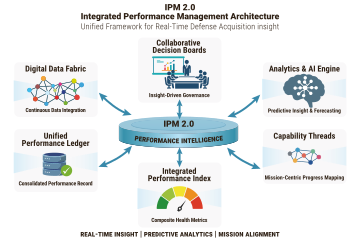
Government leaders also seek transparency without adding reporting burden to industry. They want insight derived from contractor execution systems and digital ecosystems, not additional documentation. As depicted in Figure 1, IPM 2.0 is designed to meet this expectation by using integrated data flows to produce decision ready insight.
Figure 1: IPM 2.0 Architecture.
The Performance Gap: Why Legacy Structures Fall Short
Acquisition oversight structures remain rooted in paradigms developed decades ago. Traditional program controls are constrained by data latency, data fragmentation, and retrospective orientation. These constraints limit government ability to detect risk early and to shape outcomes through timely decisions.
Data latency is a primary issue. Monthly reporting cycles can produce insight that is several weeks out of date by the time it is received and validated. This lag forces oversight bodies to base decisions on reconstructed history rather than current execution conditions. In an environment where technical and supplier conditions can change rapidly, that delay creates risk.
Data fragmentation compounds the problem. Cost systems, schedules, digital engineering repositories, DevSecOps pipelines, manufacturing systems, and risk registers often operate as separate data islands. Analysts spend substantial time reconciling these sources. This work introduces inconsistency and delay, and it shifts effort away from interpreting performance drivers and shaping decisions.
Traditional program controls are also retrospective by design. Variance based measures describe what has already occurred. They do not provide reliable insight into what is likely to happen next. They do not illuminate causal pathways across technical maturity, integration readiness, and supplier performance. As a result, oversight discussions can become debates about data interpretation rather than collaborative evaluations of options and actions.
IPM 2.0 is built to close these gaps. It provides real time integration, authoritative performance records, predictive analysis, and structured collaboration mechanisms. It enables acquisition oversight to operate with decision advantage rather than report reconstruction.
IPM 2.0: A Modern Performance Intelligence Architecture
IPM 2.0 provides an integrated, continuously updating performance ecosystem that supports real time transparency, cross domain integration, and predictive decision support. The architecture includes seven connected components that enable government and industry to operate from a synchronized understanding of program health and to act collaboratively on that insight.
The framework includes a Digital Data Fabric that integrates execution data across domains. It includes a Unified Performance Ledger that serves as the authoritative record of current program reality. It includes an Analytics and AI Engine that transforms integrated data into predictive intelligence. It includes Collaborative Decision Boards that convert insight into coordinated decisions and actions. It includes Capability Threads that connect technical maturity to mission outcomes. It includes an Integrated Performance Index that synthesizes multidimensional performance into an interpretable signal. It includes a Common Operating View that presents the data, indices, and forecasts in a shared dashboard environment.
This architecture aligns acquisition performance management with the government trend toward integrated, real time operational decision environments. It supports transparency, decision speed, and continuous learning.
Digital Data Fabric
The Digital Data Fabric is the integration layer for IPM 2.0. It continuously ingests data from cost systems, schedules, Agile development tools, digital engineering environments, DevSecOps pipelines, supplier systems, manufacturing systems, and risk tools. It replaces episodic exports and manual data assembly with automated ingestion and alignment.
The Digital Data Fabric validates, normalizes, and synchronizes incoming data using consistent iden-tifiers and timelines. It preserves traceability so that metrics and forecasts can be traced back to source systems and the time of capture. This reduces inconsistency and eliminates much of the reconciliation effort that drives reporting delays.
For government executives, the Digital Data Fabric supports transparency without expanding reporting burden. It enables insight to be produced as a natural output of execution. It also provides confidence that performance indicators are grounded in a validated and traceable data environment.
Unified Performance Ledger
The Unified Performance Ledger is the continuously updated, authoritative record of program performance generated from the Digital Data Fabric. It provides a coherent and integrated view of cost execution, schedule status, engineering maturity, supplier readiness, manufacturing progress, test readiness, and risk exposure.
Unlike static reporting packages, the ledger evolves dynamically as new data arrives. It reflects current execution conditions, and it supports drill down into underlying data when government teams need clarification. It also preserves lineage, which supports auditability and defensibility of decisions.
For government leaders, the ledger becomes a trusted foundation for performance understanding. It reduces ambiguity and enables oversight discussions to focus on decision options and risk shaping.
Analytics and AI Engine
The Analytics and AI Engine transform the integrated data in the Unified Performance Ledger into actionable foresight. It applies forecasting, anomaly detection, dependency analysis, and scenario evaluation to identify emerging risks and predict likely outcomes before they manifest as major disruptions.
This capability helps government leaders under-stand the probability of achieving upcoming mile-stones, the leading indicators driving schedule instability, and the technical maturity trajectories that influence integration readiness. It also supports decision tradeoffs by evaluating alternative scenarios and estimating their impact on cost, schedule, and capability readiness.
The intent is to support proactive decision making. Government executives gain earlier warning of risk and greater confidence in forecasts. This shifts oversight from reactive correction to anticipatory risk shaping.
Collaborative Decision Boards
Collaborative Decision Boards operationalize IPM 2.0 insight. They replace performance meetings that begin with data reconciliation with decision sessions that begin with shared, authoritative information. Participants use the Unified Performance Ledger and the outputs of the Analytics and AI Engine to diagnose causes, evaluate options, and agree on actions.
The decision board structure supports cross functional integration. Engineering, schedule, cost, risk, supplier, manufacturing, and program leadership operate from the same performance picture and address issues collaboratively. Decisions are documented with rationale and linked to underlying data, enabling traceability and learning.
For government participants, Collaborative Decision Boards increase transparency and accelerate decision cycles. They also improve partnership effectiveness because discussions focus on what to do next, rather than what happened last month.
Capability Threads and Technical Maturity Integration
Capability Threads provides a mission aligned representation of technical maturity and integration readiness. They model how engineering artifacts, integration steps, verification activities, supplier deliverables, and testing events contribute to capability outcomes.
Capability Threads enable government leaders to understand readiness in terms of capability emergence rather than work completion alone. They help identify maturity bottlenecks, integration dependencies, and technical shortfalls before those issues translate into schedule slips or cost growth. They also support clearer alignment between engineering progress and mission delivery objectives.
This approach improves government ability to engage on the drivers of performance and to align decisions with capability outcomes.
Integrated Performance Index
The Integrated Performance Index provides a single, interpretable signal of program health. It synthesizes capability readiness, schedule execution, value efficiency, and forecast confidence into a composite index that can be weighted based on mission priorities and program phase.
The index supports early detection of divergence across domains. It also supports comparability across programs within a portfolio, which improves executive ability to prioritize attention, allocate resources, and manage risk at scale. The Integrated Performance Index is designed to be actionable, not ceremonial. It is intended to support decisions that improve outcomes.
For government executives, the index provides a concise summary of multidimensional performance that can be tracked over time and used to focus decision agendas.
Common Operating View
The Common Operating View is the shared dash-board environment that presents the Unified Performance Ledger, the Integrated Performance Index, capability readiness signals, and predictive analytics in an intuitive interface. It provides real time visibility into performance drivers, and it sup-ports drilldown into underlying data when needed.
The Common Operating View enables government and industry to operate from the same current picture of program reality. It reduces time spent resolving mismatches between artifacts and it enables more direct collaboration on risk shaping and decision execution. It supports timely governance and continuous performance engagement.
Strengthening Government Insight Through Collaboration
IPM 2.0 strengthens government insight by enabling collaborative engagement that is grounded in current, reliable information. Instead of relying on compliance driven documentation, oversight becomes a shared process of interpreting integrated data, identifying risks, and evaluating action options. This shared situational awareness reduces cycle time and improves decision quality.
The model supports earlier engagement and clearer alignment. It enables government teams to intervene before risks become irreversible and to work with contractors to shape mitigation strategies. It also builds trust because both parties operate from the same authoritative sources.
This collaborative approach positions acquisition oversight as a strategic enabler. It supports mission outcomes by improving forecast credibility, accelerating decision cycles, and strengthening alignment across technical, programmatic, and risk domains.
Implications for Modern Contracting and Industry Partners
As the Department of Defense expands its use of fixed price arrangements, other transaction agreements, and performance-based constructs, contractors face increased responsibility for execution risk. These models also provide contractors with greater flexibility in how they manage execution. IPM 2.0 supports this environment by allowing contractors to manage programs through their native digital ecosystems while still delivering the continuous transparency and predictive insight the government requires.
For government customers, IPM 2.0 reduces the need for manual reporting and repeated data calls. It improves forecast credibility and supports more effective risk shaping. It strengthens alignment between contractor execution and mission out-comes, which is increasingly important in modern contracting environments.
For industry partners, adoption of IPM 2.0 can improve internal decision quality, reduce administrative overhead, and demonstrate credibility through transparent and traceable performance intelligence.
Implementation Roadmap for Government Executives
Implementing IPM 2.0 requires coordinated action across governance, infrastructure, workforce development, supplier integration, measurement, and organizational culture.
Governance should shift from periodic status reviews to continuous performance governance supported by real time dashboards and predictive indicators. Decision rights and escalation thresholds should be tied to performance signals and forecast confidence, not solely to calendar-based reviews.
Infrastructure investments should treat data integration as mission critical. Priorities should include interoperability across cost, schedule, engineering, and risk systems, scalable data architecture, robust cybersecurity, and standard interfaces that support consistent data exchange across primes and suppliers.
Workforce development should build data fluency across the acquisition community. Personnel should be trained to interpret integrated performance signals, evaluate predictive indicators, and participate effectively in cross functional decision environments.
Supplier integration should extend transparency beyond the prime contractor. Contract mechanisms should encourage digital data sharing standards that support near real time insight into supplier readiness and delivery risk.
Metrics should evolve to emphasize capability readiness, schedule execution realism, value efficiency, and forecast confidence. Dashboards should highlight trends, trajectories, and leading indicators, and they should support portfolio level comparisons that enable prioritization.
Culture should reinforce transparency, shared accountability, and continuous learning. Leaders should use IPM 2.0 insight in governance, resource decisions, and risk posture discussions. Lessons learned should be captured through decision records and outcome tracking, then reintegrated into the performance environment.
Conclusion: From Oversight to Foresight
IPM 2.0 modernizes program control by transforming it from retrospective reporting into proactive performance intelligence. It aligns acquisition management with the government shift toward real time insight and predictive decision support. It enables government executives to understand program reality as it evolves and to act earlier to shape outcomes.
By delivering integrated data, authoritative performance records, predictive analytics, and collaborative decision structures, IPM 2.0 supports decisions at the speed of need. It strengthens transparency and trust between government and industry while reducing the time and effort spent on report reconstruction. It enables acquisition oversight to become foresight, and it supports capability delivery with greater confidence, speed, and clarity.
Download this article as a PDF White Paper: Integrated Program Management 2.0
 |
Jacque Keats, CF APMP, is SMA’s Chief Operations Officer and is a recognized industry expert in the field of system integration for project management, with over 30 years of experience developing and implementing award winning scheduling, resource planning, costing, and enterprise project management systems for fortune 500 companies and government agencies. |
1. “Navy Invests $448 Million in AI and Autonomy to Accelerate Shipbuilding,” December 9, 2025, https://www.navy.mil/ Press-Office/Press-Releases/display-pressreleases/Article/4355823/navy-invests-448-million-in-ai-and-autonomy-to-accelerate-shipbuilding/
2. “GEOINT Artificial Intelligence,” https://www.nga.mil/news/ GEOINT_Artificial_Intelligence_.html
Posted on December 19, 2025, by
Dick Eassom, CF APMP Fellow, SMA, Inc.